 Child Labor, designation formerly applied to the
practice of employing young children in factories, now used to
denote the employment of minors generally, especially in work
that may interfere with their education or endanger their health.
Throughout the ages and in all cultures children joined with
their parents to work in the fields, in the marketplace, and
around the home as soon as they were old enough to perform simple
tasks. The use of child labor was not regarded a social problem
until the introduction of the factory system.
History in Great Britain
During the latter part of the 18th century in Great Britain, owners of cotton mills collected orphans and children of poor parents throughout the country, obtaining their services merely for the cost of maintaining them. In some cases children five and six years of age were forced to work from 13 to 16 hours a day.
Social reformers attempted as early as 1802 to obtain legislative restrictions against the worst features of the child-labor system, but little was done even to enforce existing laws limiting work hours and establishing a minimum age for employment. Conditions as bad as those imposed on pauper children rapidly developed in enterprises employing nonpauper children. Often with the approval of political, social, and religious leaders, children were permitted to labor in hazardous occupations such as mining. The resultant social evils included illiteracy, further impoverishment of poor families, and a multitude of diseased and crippled children.
Popular agitation for reform steadily increased. The first significant British legislation was enacted in 1878, when the minimum age of employees
 was raised to 10 years and
employers were required to restrict employment of children
between the ages of 10 and 14 to alternate days or consecutive
half days. In addition to making every Saturday a half holiday,
this legislation also limited the workday of children between 14
and 18 years of age to 12 hours, with an intermission of 2 hours
for meals and rest.
Child Labor in the U.S.
Meanwhile the industrial system developed in other countries, bringing with it abuses of child labor similar to those in Great Britain. In the early years of the 19th century children between the ages of 7 and 12 years made up one-third of the work force in U.S. factories. The shortage of adult male laborers, who were needed for agriculture, contributed to the exploitation of child laborers. In addition, the majority of adults, ostensively imbued with puritanical ideas regarding the evils of idleness among children, cooperated with employers, helping them to recruit young factory hands from indigent families.
Early Legislation
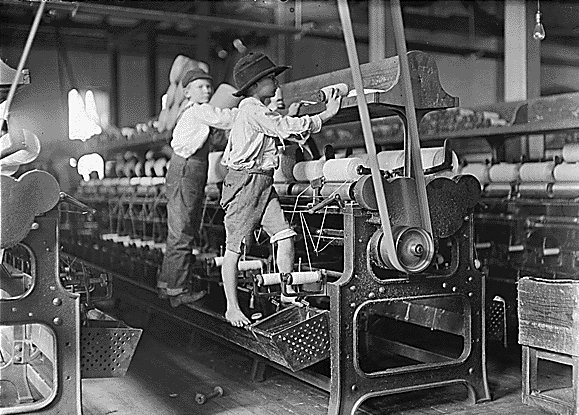 The earliest feature of the
factory system that caused concern among community leaders was
the high rate of illiteracy among child laborers. The first
effective step toward legislation governing the education of
these children was taken in 1836 when the Massachusetts
Legislature adopted a law prohibiting the employment of any child
under 15 years of age who had received less than three months of
schooling in the previous year. In 1848 Pennsylvania became the
first state to regulate the age levels of youth employed in silk,
cotton, or woolen mills by establishing a minimum age of 12.
Several other states also established minimum-age requirements,
but none of the laws passed made provisions for establishing
proof of the child's age or for enforcement.
The length of the workday for children was the next feature of the factory system to be regulated by legislation. By 1853 several states had adopted a 10-hour workday for children under 12 years of age. Despite these restrictions, the number of children in industry increased greatly in the U.S. after the American Civil War, when industrial expansion resulted in unprecedented demand for workers. By the end of the 19th century nearly one-fifth of all American children between the ages of 10 and 16 were gainfully employed. By 1910, however, as the result of the public-enlightenment activities of various organizations, notably the National Child Labor Committee, the legislatures of several states had enacted restrictive legislation that led to sharp reductions in the
 number of children employed
in industry.
Because of the lack of uniformity in child-labor standards established in the various states, a condition that placed industries in states with relatively high standards in a disadvantageous competitive position, the U.S. Congress, in 1916, passed a law that set a national minimum age of 14 in industries producing nonagricultural goods for interstate commerce or for export. In 1918, however, the U.S. Supreme Court ruled, in a 5-4 decision, that the legislation was an unconstitutional infringement on personal freedom. Another child-labor law, enacted in 1918, was also declared unconstitutional by the Supreme Court in 1922. In 1924 both houses of Congress passed an amendment to the U.S. Constitution, empowering Congress to limit, regulate, and prohibit the labor of persons under 18 years of age. The number of state legislatures that ratified the proposed amendment was 28, or 8 less than the 36 then required.
Federal Legislation
 Despite the reluctance of
state legislators to ratify the child-labor amendment,
legislative attempts to deal with the problem nationally
continued, notably during the administration of President
Franklin D. Roosevelt. The National Industrial Recovery Act,
passed by Congress in 1933, established a minimum age of 16 for
workers in most industries. In hazardous industries a minimum age
level of 18 was established. This law contributed to a
substantial decrease in the number of young workers, but the
Supreme Court ruled the act unconstitutional in 1935. In the next year Congress passed the Walsh-Healey Act,
which prohibits firms producing goods under federal government
contract from employing boys and girls under 16 years of age.
The next important legislation on the problem was the Fair Labor Standards Act of 1938, better known as the Federal Wage and Hour Law. This act was declared constitutional in 1941 by the Supreme Court, which thereby overruled its former child-labor decision under a more liberal interpretation of the commerce clause of the Constitution Article I, Section 8. The Fair Labor Standards Act, amended in 1949, applies to all workers engaged in interstate or foreign commerce. Under the child-labor provisions of the act, minors 16 years of age and over may be employed in any occupation that has not been judged hazardous by the secretary of labor. The minimum age for work in industries classified as hazardous is 18. No minimum age is set for nonhazardous agricultural employment after school hours and during vacation. Minors 14 and 15 years of age may be employed in a variety of nonmanufacturing, nonmining, and nonhazardous occupations outside school hours and during vacations for limited hours and under other specified conditions of
 work.
State Legislation
Every state today has child-labor laws. In most states employment of minors under 16 in factories and during school hours is prohibited. Other provisions include a 40-hour workweek, prohibition of night work, and work permits for minors under 18. Children working on farms are not completely protected by federal and state laws, which make no provisions for nonhazardous farm work outside school hours. The children of migratory workers, who move from harvest to harvest across the United States, are usually not subject to state laws because they do not fulfill residency requirements, and they are often unable to attend local schools, which have no provisions for seasonal increases in school enrollment. Other children exempted from federal and state labor laws are children employed as actors and performers in radio, television, and motion pictures, as newspaper deliverers and sales personnel, or as part-time workers at home.
International Problems
 In the latter part of the
20th century, child labor remains a serious problem in many parts
of the world. Studies carried out in 1979, the International Year
of the Child, show that more than 50 million children below the
age of 15 were working in various jobs often under hazardous
conditions. Many of these children live in underdeveloped
countries in Latin America, Africa, and Asia. Their living
conditions are crude and their chances for education minimal. The
meager income they bring in, however, is necessary for the
survival of their families. Frequently, these families lack the
basic necessities of life-adequate food, decent clothing and
shelter, and even water for bathing.
In some countries industrialization has created working conditions for children that rival the worst features of the 19th-century factories and mines. In India, for example, some 20,000 children work 16-hour days in match factories.
Child-labor problems are not, of course, limited to developing nations. They occur wherever poverty exists in Europe and the United States. A growing concern in recent years has been the increase in prostitution among youngsters in urban centers.
The most important efforts to eliminate child-labor abuses throughout the world come from the International Labor Organization or ILO, founded in 1919 and now a special agency of the United Nations. The organization has introduced several child-labor conventions among its members, including a minimum age of 16 years for admission to all work, a higher minimum age for specific types of employment, compulsory medical examinations, and regulation of night work. The ILO, however, does not have the power to enforce these conventions; it depends on voluntary compliance of member nations.