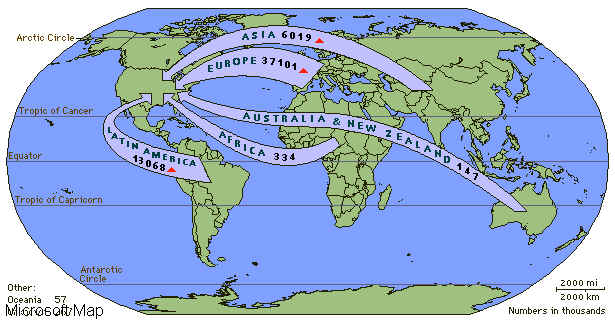
 Immigration, transfer of residence from one country
to another, regarded from the standpoint of the country in which
the new residence is taken. Immigration has always been important
in the diffusion of culture. In modern times, the first great
immigration was the colonizing movement of the 16th and 17th
centuries, which introduced essential features of Western
European civilization to the New World. Immigration, on a world
scale, reached a peak in the 19th and 20th centuries.
Immigration to the U.S.
The first immigrants to the territory now constituting the United States were from Western Europe. The first great influx began early in the 19th century when large numbers of Europeans left their homelands to escape the economic distress resulting from the transformation of industry by the factory system and the concurrent shift from small-scale to large-scale farming. At the same time, wars, political oppression, and religious persecution caused a great many Europeans to seek freedom and security in the U.S.
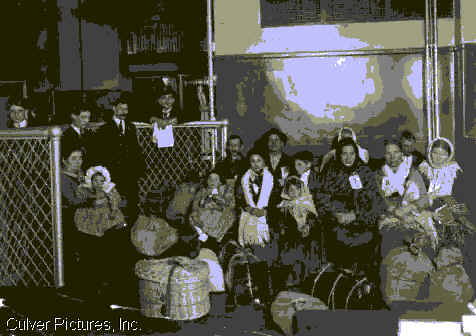
The century following 1820 may be divided into three great periods of immigration to the U.S. During the first period, from 1820 to 1860, most of the immigrants came from Great Britain, Ireland, and western Germany. In the second period, from 1860 to 1890, those countries continued to supply a majority of the immigrants; the Scandinavian nations provided a substantial minority. Thereafter the proportion of immigrants from northern and Western Europe declined rapidly. In the final period, from 1890 to 1910, fewer than one-third of the immigrants came from these regions. The majority of the immigrants were natives of southern and Eastern Europe, with nationals of Austria, Hungary, Italy, and Russia constituting more than half of the total. Until World War I, immigration had generally increased in volume annually. From 1905 to 1914 an average of more than a million aliens entered the U.S. every year. With the outbreak of war, the volume declined sharply, and the annual average from 1915 to 1918 was little more than 250,000. In 1921 the number again rose 800,000 immigrants were admitted. Thereafter the number fell in response to new conditions in Europe and to the limitations established by U.S. law.
Legislation Regulating Immigration
The first measure restricting immigration enacted by Congress was a law in 1862 forbidding American vessels to transport Chinese immigrants to the U.S. 20 years later Congress passed the Chinese Exclusion Act excluding Chinese immigrants. In 1875, 1882, and 1892, acts passed by Congress provided for the examination of immigrants and for the exclusion from the U.S. of convicts, polygamists, prostitutes, persons suffering from loathsome or contagious diseases, and persons liable to become public charges. The Alien Contract Labor Laws of 1885, 1887, 1888, and 1891 prohibited the immigration to the U.S. of persons entering the country to work under contracts made before their arrival; professional actors, artists, singers, lecturers, educators, ministers, and personal and domestic servants were exempt from this provision. Alien skilled laborers,
 under these laws, were permitted to enter the U.S.
to work in new industries. A diplomatic agreement made in 1907 by
the U.S. and Japan provided that the Japanese government would
not issue passports to Japanese laborers intending to enter the
U.S.; under the terms of this agreement, the U.S. government
refrained until 1924 from enacting laws excluding Japanese
immigrants.
In 1917 Congress passed an immigration law that enlarged the classes of aliens excludable from the U.S.; its basic provisions were, with some changes, retained in subsequent revisions of the immigration law. It imposed a literacy test and created an Asiatic Barred Zone to shut out Asians. Aliens unable to meet minimum mental, moral, physical, and economic standards were excluded, as were anarchists and other so-called subversives. The Anarchist Act of 1918 expanded the provisions for the exclusion of subversive aliens.
After World War I a marked increase in racism and the growth of isolationist sentiment in the U.S. led to demands for further restrictive legislation. In 1921 a congressional enactment provided for a quota system for immigrants, whereby the number of aliens of any nationality admitted to the U.S. in a year could not exceed 3 percent of the number of foreign-born residents of that nationality living in the U.S. in 1910. By its terms, the law applied to nations of Europe, the Middle East, Africa, Australia, New Zealand, Asian Russia, and certain islands in the Atlantic and Pacific.
In 1924, the basic immigration quotas were changed; the new law provided for annual immigration quotas for all countries from which aliens might be admitted. Quotas were based on the presumed desirability of various nationalities; aliens from northern and Western Europe were considered more desirable than those from southern and Eastern Europe. Aliens who fulfilled lawful residence requirements were exempt from quotas, as were alien wives, children, and some husbands of U.S. citizens.
In 1941 Congress passed an act providing for the refusal of visas to aliens whose presence in the U.S. would endanger public safety. Immigration legislation passed after 1941 included a congressional act of 1943, repealing the laws barring Chinese from entering the U.S. and allowing their admission to the country in accordance with an annual quota. A federal law passed in 1945 authorized for a limited time the admission to the U.S., without regard to quota and physical and other standards, the wives and children of citizens serving in or honorably discharged from the armed forces of the U.S. during World War II.
A federal law of 1946 authorized the admission to the U.S., under annual quota, of persons of races indigenous to India. Legislation was enacted by Congress in 1948 to permit the immigration before July 1, 1950, of 202,000 European displaced persons, that is, persons driven from their homes in the years preceding World War II as a result of political or racial persecution and those forcibly transported from their homes during World War II; the number admitted was to be deducted from subsequent annual quotas for the various nationalities.
Most of the laws relating to immigration were by the Immigration and Nationality Act of 1952. The Refugee Relief Act of 1953 made an additional allocation of places for the victims of war and disaster. The 1965 amendments to the Immigration and Nationality Act abolished the national-origin quotas and established an annual limitation of 170,000 visas for immigrants from eastern hemisphere countries. Another law, effective in 1968, provided for an annual limitation of 120,000 immigrants from the western hemisphere, with visas available on a first-come, first-served basis. In 1977 an amendment to the Immigration and Nationality Act changed the quota to 290,000 immigrants worldwide, with a
 maximum of 20,000 for any one
country, thus abolishing separate limitations for each
hemisphere. At the same time, a system was set up for western
hemisphere immigrants, giving preference to those who are related
to U.S. citizens or permanent resident aliens and to workers
whose skills are needed in the U.S. The Refugee Act of 1980
reduced the worldwide quota to 270,000 persons, while retaining
the preference system. Spouses, children, and parents of U.S.
citizens are exempt from numerical limitation, as are certain
categories of special immigrants. The United States takes in
thousands of refugees each year; between 1981 and 1986, for
example, about 500,000 Southeast Asian refugees entered the
country.
In the 1980s concern about the surge of illegal aliens into the U.S. has led Congress to pass legislation aimed at curtailing illegal immigration. The Immigration Reform and Control Act of 1986 allows most illegal aliens who have resided in the U.S. continuously since January 1, 1982, to apply for legal status. In addition, the law prohibits employers from hiring illegal aliens and mandates penalties for violations.